Loading

Hello There!

Lorem ipsum dolor sit amet, consectetur adipiscing elit,

Information

Follow Us

info@kongucollege.com

Dheeran Chinnamalai Nagar, Vennamalai, Karur, Tamil Nadu 639006, India

Physics

Department of Physics

About
Department of Physics

Department of Physics at Kongu college of Arts and Science was established in the year of 2015 with an ambition to provide students with the scientific knowledge and skills needed to begin their careers or to enter graduate, researcher, scientists and citizens. Now the department was developed with modern facilities, infrastructure, well established laboratory and providing an enthusiastic atmosphere for the students to work around. Studying Physics develop scientific temper and encourages the student to innovate in diverse research and technical areas.

The department offer program (B.Sc Physics) at undergraduate level under the faculty of Science. B. Sc Physics is an undergraduate course in the field of science. The course of study educates the students with various aspects of matter, motion, energy, time and basic science. This undergraduate course offer adequate scope with regard to higher education as well as career.
Vision:

To develop the institution and department as a center of excellence by imparting quality education in basic physics and technical disciplines, with a strong focus on research and innovation to meet the needs of society.

Mission:
      • ✔ To provide strong scientific knowledge and practical skills that prepare students for careers, higher studies, and research.

      • ✔ To nurture competent researchers and professionals capable of innovation and lifelong learning.

      • ✔ To develop responsible scientists and citizens who contribute meaningfully to societal growth and development.

Objectives:

 ✔ To provide the students with a broad understanding of the basic concept of Physics, to help them to develop critical thinking, to solving scientific problems and to developing soft skills.

 ✔  To develop the ability of the students to conduct, observe, analyze and report experimental and theoretical problems.

 ✔  To provide the students, the method of teaching based on current scientific knowledge about education, needs of the students and needs of the society.

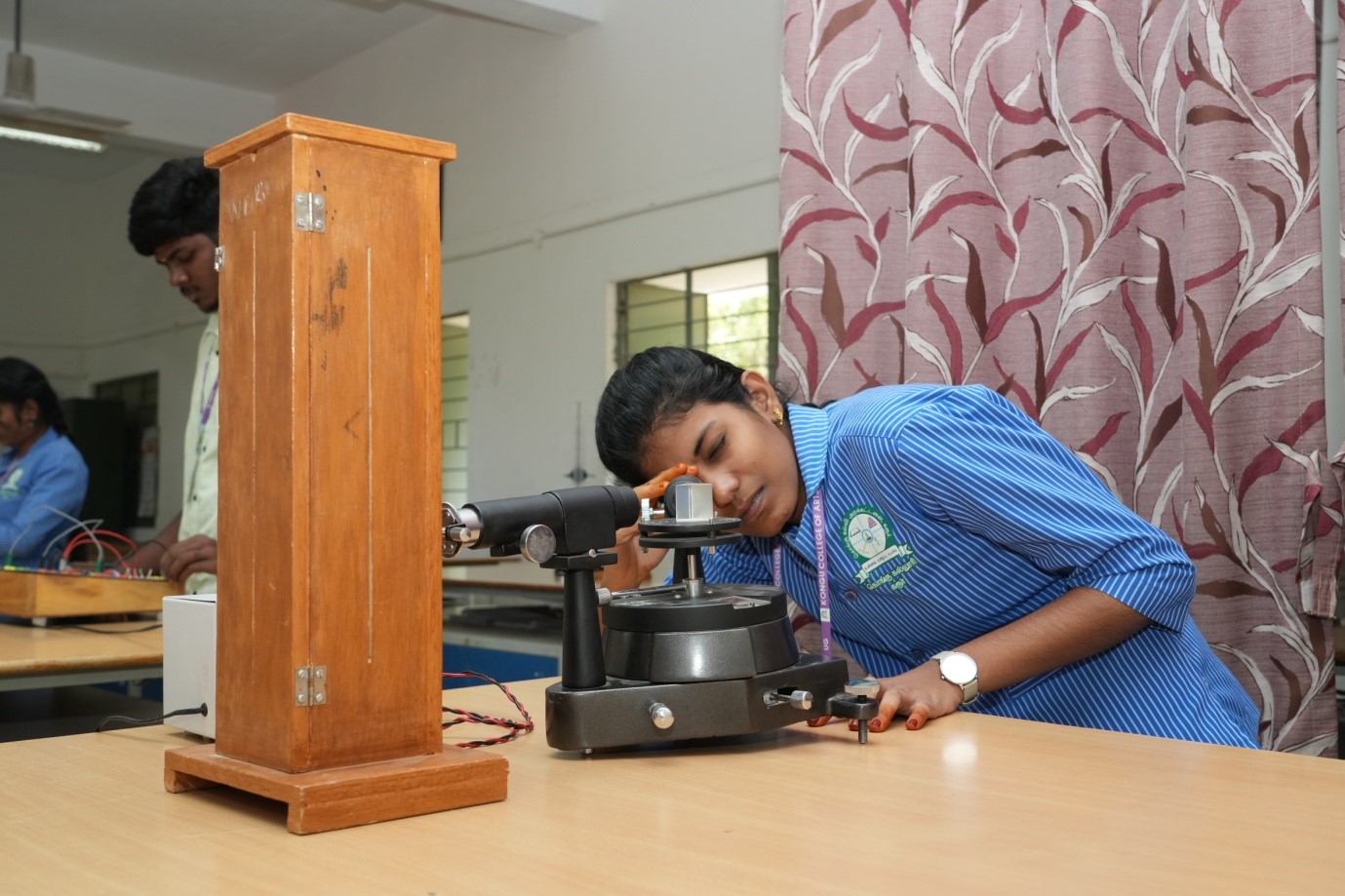
The Physics Laboratory of the Kongu College Of Arts and Science is well-equipped and systematically organized to support effective teaching and learning at the undergraduate levels. The laboratory provides a strong practical foundation in core areas such as Mechanics, Optics, Electricity and Magnetism, Electronics, and Modern Physics, enabling students to correlate theoretical principles with experimental observations.

Department Staffs:

Gemini_Generated_Image_ldfa1vldfa1vldfa (1)-Photoroom
S. Kanimozhi

M.Sc., M. Phil

Head of the Department

Gemini_Generated_Image_ldfa1vldfa1vldfa (1)-Photoroom
Ms.T.Vidhya

M.Sc., M. Phil., B.Ed.,

Assistant Professor

B.Sc. Physics

Department of PHYSICS

About:

Department of Physics at Kongu college of Arts and Science was established in the year of 2015 with an ambition to provide students with the scientific knowledge and skills needed to begin their careers or to enter graduate, researcher, scientists and citizens. Now the department was developed with modern facilities, infrastructure, well established laboratory and providing an enthusiastic atmosphere for the students to work around. Studying Physics develop scientific temper and encourages the student to innovate in diverse research and technical areas.

The department offer program (B.Sc Physics) at undergraduate level under the faculty of Science. B. Sc Physics is an undergraduate course in the field of science. The course of study educates the students with various aspects of matter, motion, energy, time and basic science. This undergraduate course offer adequate scope with regard to higher education as well as career.
Vision:

To develop the institution and department as a center of excellence by imparting quality education in basic physics and technical disciplines, with a strong focus on research and innovation to meet the needs of society.

Mission:
  • .To provide strong scientific knowledge and practical skills that prepare students for careers, higher studies, and research.

  • .To nurture competent researchers and professionals capable of innovation and lifelong learning.

  • .To develop responsible scientists and citizens who contribute meaningfully to societal growth and development.

Objectives:

· To provide the students with a broad understanding of the basic concept of Physics, to help them to develop critical thinking, to solving scientific problems and to developing soft skills.

· To develop the ability of the students to conduct, observe, analyze and report experimental and theoretical problems.

· To provide the students, the method of teaching based on current scientific knowledge about education, needs of the students and needs of the society.

Department Staffs:

Ms.T.Vidhya

Assistant Professor

Course Details

Duration

Typically, BSc Physics is a three-year program.

Curriculum

Classical Mechanics

Study of motion and forces in classical physics.

Electromagnetism

Principles of electricity and magnetism.

Quantum Mechanics

Introduction to the principles of quantum physics.

Thermodynamics and Statistical Mechanics

Study of heat, temperature, and statistical mechanics.

Optics

Properties and behavior of light.

Nuclear Physics

Study of atomic and nuclear structure.

Mathematical Physics

Application of mathematical methods in physics.

Experimental Physics

Practical laboratory work to reinforce theoretical concepts.

Electronics

Basics of electronic circuits and devices.

Internship/Project Work

Some programs include hands-on research projects or internships.

Career Opportunities

Research and Development

Research Scientist

Conducting experiments and contributing to scientific advancements.

Laboratory Technician

Assisting in experimental work in laboratories.

Academia

Teaching

At the school or college level. A postgraduate degree (MSc, PhD) may be required for higher education positions.

Engineering Analyst

Applying physics principles in various engineering fields.

Electronics Engineer

Working on the design and development of electronic systems.

Information Technology

Data Analyst

Analyzing and interpreting data using statistical methods.

Software Developer

Utilizing analytical and problem-solving skills in software development.

Medical Physics

Medical Physicist

Ensuring the safe and effective use of radiation in medical procedures.

Astronomy and Astrophysics

Astronomer

Studying celestial bodies and phenomena.

Astrophysicist

Investigating the physical properties of celestial objects.

Environmental Science

Environmental Scientist

Analyzing and interpreting environmental data.

Government Jobs

Scientific Officer

In government research institutions or laboratories.

Defence Services

Opportunities in defense-related research and development.

Energy Sector

Energy Analyst

Analyzing and optimizing energy systems.

Renewable Energy Specialist

Focusing on sustainable energy solutions.

Telecommunications

Telecommunications Engineer

Designing and maintaining telecommunications systems.

Material Science

Materials Scientist

Studying the properties and applications of materials.

Finance and Banking

Quantitative Analyst

Applying mathematical and statistical models to financial markets.

Space Research Organizations

Space Scientist

Contributing to space exploration and research.

Technical Writing and Science Journalism

Science Writer/Journalist

Communicating scientific concepts to the public.

Entrepreneurship

Startups

Establishing ventures related to technology or physics applications.